The research team led by Professors Yiwang Chen and Licheng Tan at Nanchang University designed and synthesized caesium 4-(diphenylphosphino)benzoate, which enables efficient Cs⁺ doping and homogeneous cation distribution, yielding high-quality perovskite films with greatly improved phase stability. The relevant findings were published in Nature Energy on 27 March 2026 under the title: Controlled Cs⁺ incorporation through organocaesium salts in α-FA–Cs perovskite solar cells with a certified efficiency of 26.61%.
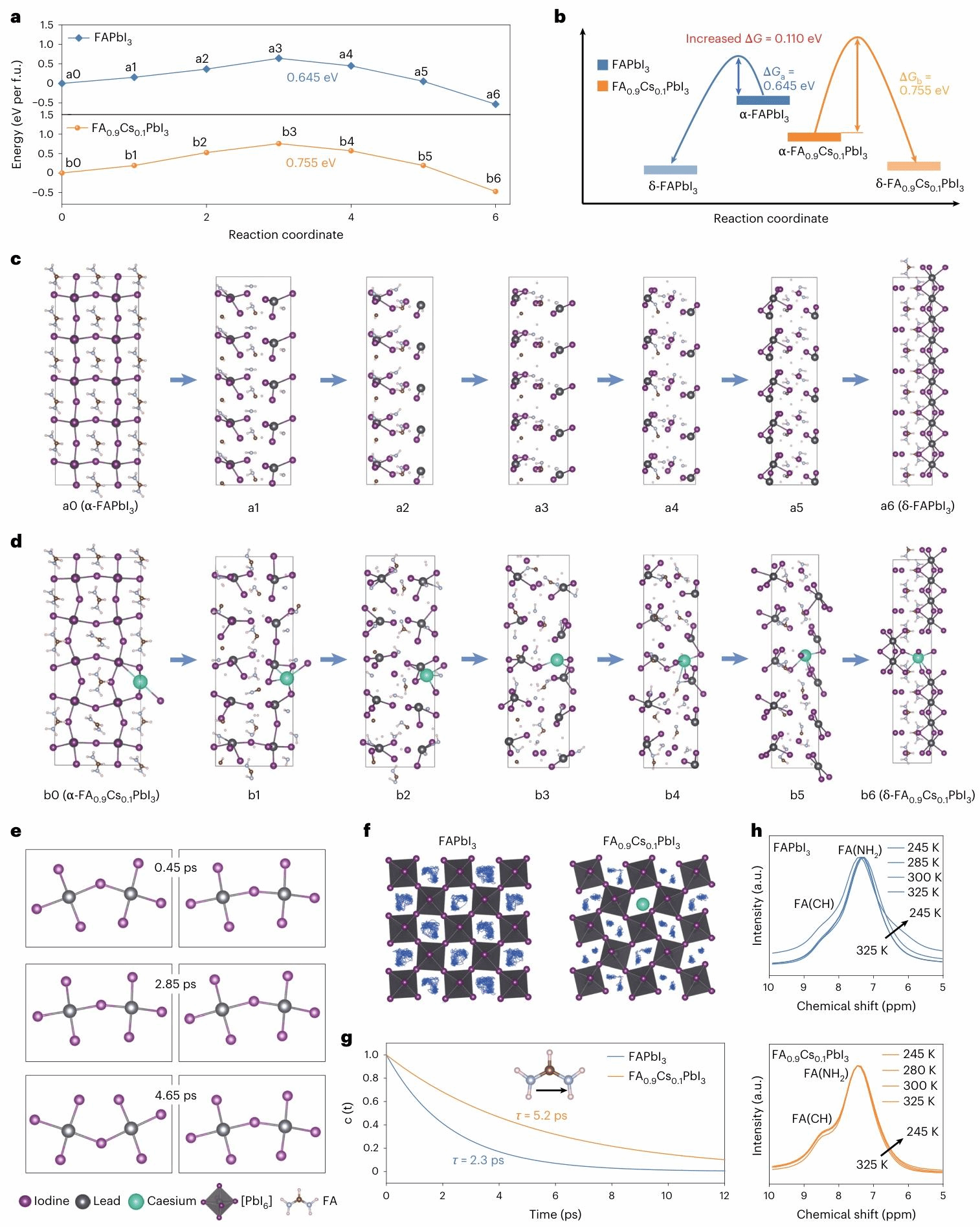
Perovskite solar cells fabricated via this two-step method achieve a power conversion efficiency (PCE) of 26.91% (certified efficiency: 26.61%). Devices integrating this perovskite layer with a thermally stable charge-transport layer retain 95% of their initial efficiency (23.76%) after 1,500 hours of continuous operation under 1-sun illumination at maximum power point tracking (MPPT) and 85 °C (in accordance with the ISOS-L-2 testing protocol). This study clarifies the phase transition pathway and corresponding transition-state structures of FA₀.₉Cs₀.₁PbI₃, and unveils the intrinsic mechanism of lattice stabilization driven by caesium ions in perovskites.