Recently, the research team led by Professors Yiwang Chen and Licheng Tan from the School of Chemistry and Chemical Engineering / Institute of Polymer and Energy Chemistry, Nanchang University, has achieved significant progress in the research of large-area perovskite photovoltaic fabrication under ambient conditions. The related work, entitled “Spatiotemporally homogeneous crystallization for ambient scalable perovskite photovoltaics”, has been published in Science, a top international academic journal. Binlou Gao, a master’s student at Nanchang University, serves as the first author of the paper, and postdoctoral researcher Yang Zhong is the co-first author. Professors Yiwang Chen and Licheng Tan are the co-corresponding authors.
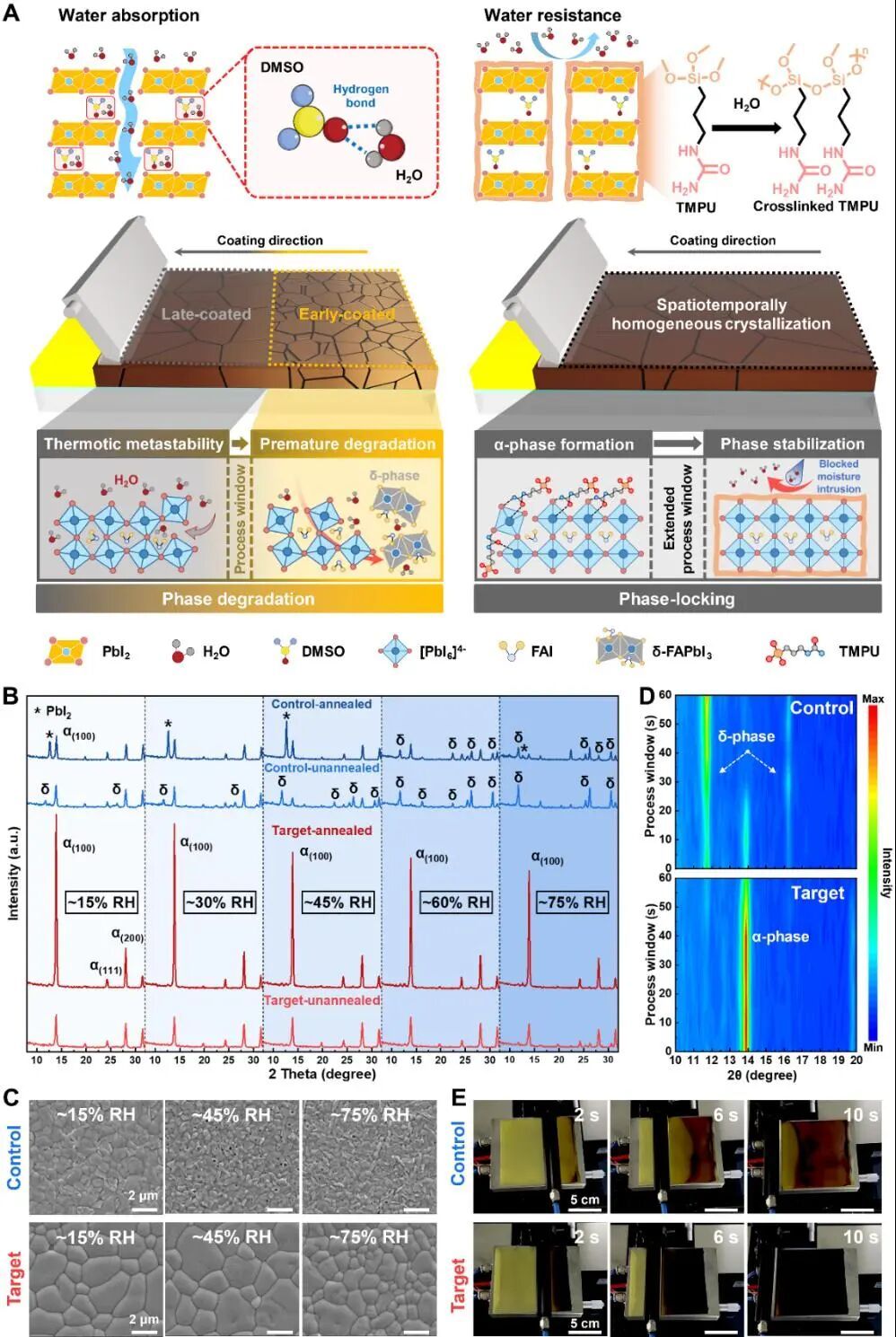
The commercialization of perovskite photovoltaic technology still faces multiple common challenges. Conventional fabrication processes for small-area devices mostly rely on inert atmospheres and spin-coating techniques, which are difficult to adapt to high-throughput and large-scale manufacturing requirements. Meanwhile, large-area film formation under ambient air generally suffers from insufficient spatiotemporal homogeneity of crystallization, and the thin films are prone to degradation induced by moisture. To tackle these issues, the team innovatively proposed a “phase-locking” strategy. A bifunctional molecule, 3-ureidopropyltrimethoxysilane (TMPU), containing ureido coordination groups and trimethoxysilane crosslinking groups, was introduced into the PbI₂ precursor. In-situ crosslinking reactions with moisture in ambient air generate a hydrophobic dynamic protective layer. In addition, strong coordination interactions between ureido groups and lead-based intermediates enable synergistic regulation of crystallization kinetics and phase stability over a wide humidity range.
On the one hand, this strategy lowers the formation energy barrier of the photoactive perovskite phase, directs direct crystallization of thin films into the highly stable photoactive phase, and effectively mitigates structural defects originating from phase transitions. On the other hand, the combined physical barrier effect and dynamic bonding of the crosslinked network block the invasion of ambient moisture and alleviate premature degradation of pre-deposited regions, thereby remarkably ameliorating the spatiotemporal inhomogeneity of crystallization during large-area perovskite deposition. This work systematically correlates crystallization kinetics, environmental tolerance and large-area film uniformity. It makes important advances in addressing the universal technical bottlenecks of severe degradation and poor uniformity of large-area perovskite thin films fabricated under ambient conditions, and provides scientific fundamentals and technical routes for translating lab-scale small-area perovskite photovoltaic devices into industrial large-area modules.
Employing blade coating, a commercially compatible deposition method based on the proposed strategy, the team fabricated photovoltaic cells with an efficiency of 26.7%, and the certified efficiency by an authoritative third-party institution reached 26.1%. When scaled up to rigid, flexible and carbon-based modules with an area of 100 cm², all devices exhibited favorable performance. Long-term stability tests reveal that encapsulated devices maintain over 90% of their initial efficiency after 1500 hours of continuous operation under 1 sun illumination at 85 °C in ambient air, and after 2300 hours under the commercial standard damp-heat “double 85” test (85 °C and 85% relative humidity), demonstrating promising potential for commercial translation.